

Every joint.The whole body.One view. — Dr. Amirhossein Peyravi
Internal Medicine Specialist, Rheumatology Subspecialist Tabriz
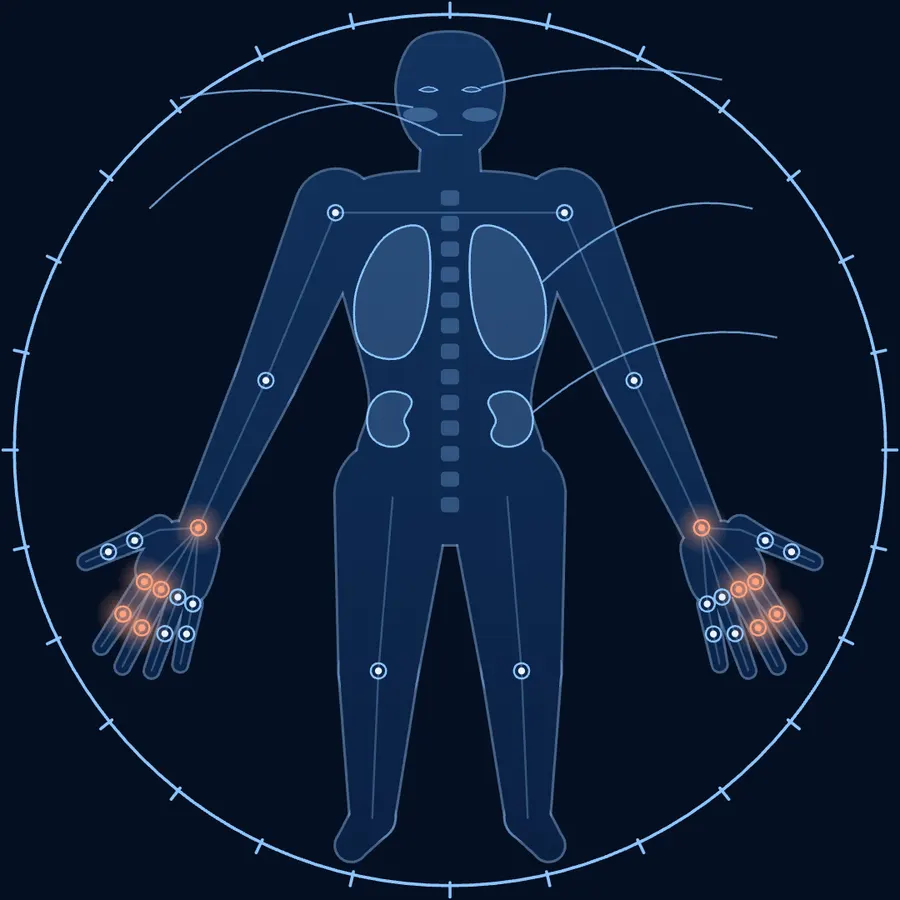
Joint pain is sometimes more than joint pain. Skin, eyes, tiredness and blood tests have to be read together. Here you can see how that works.
Sometimes the signs are not separate.
Dr. Amirhossein Peyravi is an internal medicine specialist and rheumatologist in Tabriz. Rheumatology deals with diseases of the joints, muscles and bones, most of them linked to the immune system. Joint pain, tiredness, mouth ulcers, rashes or a red eye can be signs of one disease, and many patients have seen several doctors before they reach a diagnosis. Training in internal medicine helps these signs to be read together. This site explains what each disease is, what the tests and medicines are for, and when not to wait for an appointment.
More about the doctorWhat has worried you?
Most patients arrive with a symptom, not the name of a disease. Tap your symptom or question. This list does not give a diagnosis or replace an examination.
- My joints are stiff in the morning
- Back pain that rest does not ease
- Sudden pain in my big toe
- Repeated mouth ulcers
- A facial rash after sun
- Normal tests, but I am in pain
- Tiredness that sleep does not fix
- What is a biologic medicine?
- What should I eat?
- What do I bring to the first visit?
- My disease has flared
- Pregnancy and these medicines
A hot, swollen joint with a fever, a fever while on medicines that lower immunity, sudden loss of vision, a new headache with pain at the temples, breathlessness or severe chest pain cannot wait for an appointment. Get help the same day or call 115 (Iran's emergency number). When should I act urgently?
Five groups of disease, in plain language.
These pages explain the signs of each disease, how it is checked, what treatment generally looks like and when to get help urgently. Each patient's plan is set by the doctor after an examination and the results.
Rheumatoid arthritis
The immune system attacks the lining of the joints by mistake. Joints become painful, swollen and stiff, mostly in the hands, feet and wrists. Early treatment can prevent joint damage, so seeing a doctor early matters.
Read moreLupus
An autoimmune disease with many faces: joint pain, extreme tiredness and rashes that follow sun exposure. The kidneys and heart can be affected too.
Read moreSpondyloarthritis
Long-lasting back pain and stiffness that often begins in the teens or twenties, and the arthritis that comes with psoriasis.
Read moreGout
Sudden, severe joint pain, often in the big toe. With the right treatment it is one of the most controllable forms of arthritis.
Read moreBehcet's disease and vasculitis
Inflammation of the blood vessels: repeated mouth and genital ulcers, a red and painful eye and, later in life, a new headache with pain at the temples.
Read more
From the first sign to follow-up years later
A rheumatic disease is not settled in one visit. Each stage has a clear job, and you know what is coming before it starts.
- Step 1 of 5.
Listening and a whole-body exam
You are asked when the symptoms began, what mornings are like, and what makes things better or worse. The joints are examined, and so are the skin, eyes, mouth and the rest of the body.
- Step 2 of 5.
Tests and imaging
Blood and urine tests and, when needed, X-ray, ultrasound or MRI. Bring your earlier results too, because the change over time can say more than a single number.
- Step 3 of 5.
Putting it together: the diagnosis
No single test proves or rules out these diseases. A diagnosis comes from the history, the exam and the results together, and sometimes it takes time to become clear.
- Step 4 of 5.
Starting and monitoring medicine
After the diagnosis, the treatment plan and its aim are gone through with you. Most of these medicines need regular blood tests, and the dose or the medicine may change over time.
- Step 5 of 5.
Long-term follow-up
These diseases have ups and downs. Follow-up visits check how active the disease is and any side effects. If you have a flare or plan a pregnancy, get in touch early.
With you at every stage of diagnosis, treatment and follow-up.
Rheumatic disease care runs on regular tests and follow-up. The patient support form has six sections: laboratory, imaging, pharmacy, referral to doctors, rehabilitation and wellbeing, and services at home.
Medical diagnostic laboratory
Quick appointments and results, free blood collection at home or at work, and reminders for periodic tests.
Medical imaging and ultrasound
CT scan, MRI, ultrasound, PET scan, bone scan and mammography.
Pharmacy and specialty medicines
For specialty medicines, you write the name of the pharmacy on the form.
Referral to specialists and sub-specialists
You write the name of the doctor or the specialty you want on the form.
Rehabilitation and wellbeing
Quick appointments and referral to rehabilitation and wellbeing specialists, arranged by the support team.
Treatment and rehabilitation at home
Doctor visits, clinical nursing, physiotherapy, rehabilitation and bedsore care at home.
Wherever the form says "free", that service is free.
Simple answers to the first questions.
What does a rheumatologist treat?
A rheumatologist diagnoses and treats diseases of the joints, muscles and bones and autoimmune diseases, such as rheumatoid arthritis, lupus, spondyloarthritis, gout and vasculitis.
My tests are normal. Does that rule out a rheumatic disease?
Not necessarily. Some people have rheumatoid arthritis with normal blood tests, and no single test proves or rules out these diseases. A diagnosis comes from the history, the examination and the results together.
Do these diseases go away?
Most are long-term and have no definite cure, but with early diagnosis and suitable treatment many patients can have long periods without flares and carry on with life and work. With the right treatment, gout is one of the most controllable forms of arthritis.
Why do I need regular blood tests?
Tests show how active the disease is and check that a medicine is not harming the blood, liver or kidneys. Many side effects show up in tests before you feel anything. Your doctor sets your test schedule.
I feel better. Can I stop my medicine?
Do not stop by yourself. Stopping some medicines suddenly, steroids above all, can be dangerous, and the disease may come back. If you think you should not continue, talk to your doctor before you change anything.
Can I get pregnant on these medicines?
Many patients have healthy pregnancies, but it needs planning. Some medicines, such as methotrexate, are not recommended in pregnancy and must be changed before you stop contraception. Tell your doctor early.
Do I need a special diet?
No food or diet treats these diseases. Balanced food and a healthy weight help your general health. In gout, cutting down on alcohol, sugary drinks and purine-rich foods matters more. Ask before you take any herbal remedy or supplement.
When should I act urgently?
A hot, swollen joint with a fever, a fever on medicines that lower immunity, sudden loss of vision, a new headache with pain at the temples, breathlessness and severe chest pain cannot wait for an appointment. The full list is in the patient guide.
Where is the office and what are the hours?
The address and hours will be announced once the doctor confirms them.
Do you work with insurance?
The list of insurers will be announced soon.
These answers are general and do not replace your doctor's advice for your situation.
The first step: putting the signs together.
Go to the booking page or talk to support. Have your earlier test results and your medicine list ready.
Support number